

Is the AI bubble bursting? What the Fed's rate hike means for AI stocks in 2026
Rising rates now test which AI spending is backed by customers who pay.
Updated November 9, 2026

By Jack AI Tech Brief
Editorial team
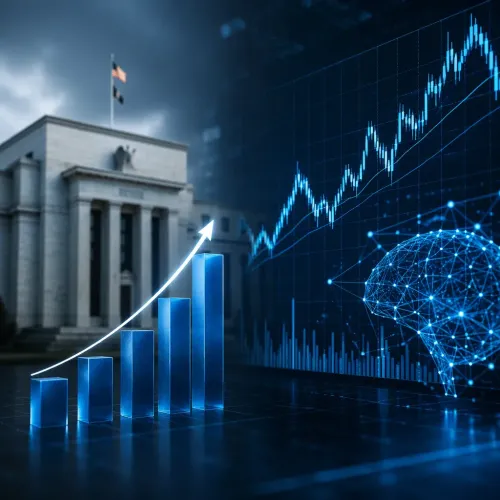
In short: The Federal Reserve raised its target range for the federal funds rate to 3-3/4 to 4 percent on 16 September 2026 [1], and officials see another increase possible this year [2]. AI builders borrow to fund data centers, so higher rates raise their costs. Meta's Reality Labs posted a $19.19 billion operating loss in 2025 on $2.21 billion of revenue [3].
Key Facts
- Fed target range after the September 2026 increase
- 3-3/4 to 4 percent
- As of September 16, 2026
- Meta Reality Labs operating loss, 2025
- 19.19 billion USD
- As of December 31, 2025
What did the Fed do in September 2026?
The Federal Reserve set its target range for the federal funds rate at 3-3/4 to 4 percent on 16 September 2026 [1]. The Fed's implementation note directs the trading desk to "maintain the federal funds rate in a target range of 3-3/4 to 4 percent" [1]. CNBC reported that the Fed approved its first interest rate hike in more than three years and indicated another is to come [2].
Updated projections showed that a strong majority of officials think another hike is possible later this year [2]. The next move depends on inflation, which is why the decision matters for every business that borrows.
Why do higher rates reach AI companies?
AI builders often spend on chips, power and staff before their products earn revenue. A higher rate makes that gap more expensive to carry, and that is one way the decision reaches the AI trade.
Fortune reported in September that Capital Economics had built a detailed case that the AI trade is a late-stage bubble [4]. That is one forecaster's view, not a fact about any company. Fortune also wrote that the Federal Reserve may be about to do the one thing that has historically ended booms like this [4].
The counterview is also in that report. It argues the AI build-out "is mostly rate-insensitive," meaning a Fed hike or two is unlikely to stop hyperscaler capital spending [4]. The two views together suggest the AI trade is exposed to monetary policy, though the sources disagree on how much.
Does AI spending add to inflation?
CNBC reported that economists see expanded AI investment as a possible source of inflation [2]. The same report said the hike is part of an effort aimed at combating inflation brought on by spiraling oil prices and other factors [2].
So the Fed faces two inflation sources at once. If AI spending adds to demand, the central bank could need higher rates for longer, which raises the cost of funding that spending. This loop is one way the September decision links the price of AI infrastructure to the price of money.
What does Meta's Reality Labs spending show?
The Reality Labs segment is named in Meta's 10-K, which reports operating losses of (19,193) million dollars in 2025, (17,729) million in 2024 and (16,120) million in 2023 [3]. Across those three years the unit lost about $53 billion, and the loss grew in each year of the table [3].
Revenue for the segment was $2.21 billion in 2025 [3]. That means the operating loss was roughly $8.70 for every dollar of revenue, a clear sign that the spending ran far ahead of the income it produced.
The sources here do not show whether that hardware spending later fed Meta's AI work, so this article does not make that claim. The narrower lesson for AI is that large, long spending needs a path to paying customers, and the cost of waiting for that path rises when rates rise.
How can readers tell a bubble from a correction?
A bubble is clear only in hindsight, so readers need signals they can check before then. Three checks help. First, whether revenue from AI products grows at a similar pace to the capital spent on them. Second, whether companies pay for the capacity they build, or whether the spending depends on debt that works only while rates stay low. Third, whether the business case still holds at higher borrowing costs.
Each check uses figures that a company or a central bank publishes, so none needs a forecast.
What should readers watch next?
Three signals matter more than any single forecast. The first is the Fed's next decision and the inflation data behind it. The second is how much AI companies borrow to build data centers. The third is whether AI revenue grows as fast as the capital spent to create it.
None of these signals confirms a bubble on its own. Meta's own filing expects its 2026 Reality Labs operating losses to remain similar to 2025 [3], so the cost of that bet is not falling yet.
Frequently Asked Questions
Did the Fed raise interest rates in 2026?
Yes. On 16 September 2026 the Fed set its target range for the federal funds rate at 3-3/4 to 4 percent [1].
Does a higher rate hurt AI companies?
It raises the cost of borrowing, which matters most for companies that fund large data center builds with debt before their revenue grows to match.
Is this article investment advice?
No. It explains how rate changes and spending connect to the AI trade. It does not tell readers what to buy or sell.
Sources
- 1.Implementation Note issued September 16, 2026 (opens in new tab) — Federal Reserve Board
- 2.
- 3.Meta Platforms, Inc. Form 10-K for fiscal year 2025 (opens in new tab) — U.S. Securities and Exchange Commission
- 4.
Tags
Written with AI assistance and reviewed by a human editor before publication.How we produce this content.